

Money Transmitter Licensing
Money Transmitter Licensing
__________________________________________________________________
Stricter Federal and State Regulations for Virtual World Currency Transactions
FinCEN released guidance on the “Application of FinCEN’s Regualations to Persons Administering, Exchanging, or Using Virtual Currencies” on March 18, 2013.[1]The guidance clarifies the requirements for businesses and individuals making use of virtual currency in regards to MSB registration with FinCEN. This clarification is of significant importance due to the booming expansion of Virtual Worlds like Second Life, Entropia Universe, and others. Many users login to these virtual world grids and purchase in game currency without giving much thought to state or federal regulations regarding the purchase of said currency. Last year, there were many discussions circulating the web about who would need to register as an MSB according to FinCEN’s March 18, 2013 Guidance on Virtual Currencies.
Debates as to what type of MSB various companies, like Linden Lab, would fall under produced great insight into the complex problem that arises from the trickle effect which federal regulation would have upon state regulation of companies making use of virtual currency. There are seven kinds of MSBs denoted by the Code of Federal Regulations (CFR). They are as follows:
1) Dealer in foreign exchange
2) Check casher
3) Issuer or seller of traveler’s checks or money orders
4) Provider of prepaid access
5) Money transmitter
6) U.S. Postal Service
7) Seller of prepaid access [2]
The type of MSB designation presenting the greatest problem is that of the money transmitter. Companies falling under the designation of a money transmitter have to comply with federal regulation by registering as an MSB and must also comply with state regulations in most states where money transmitter activity is to take place. Herein lies the dilemma. There are currently 53 states and territories which have individual licensing requirements for money transmitters.[3]The licensing requirements are costly and mandate various procedures for continued licensing which are extremely strict and time consuming in regards to implementation.
For example, Company A wishes to provide a currency exchange for virtual world B’s virtual currency online. Company A begins operating the currency exchange and only employs individuals in State 1, where Company A is organized and operates. However, residents from states 1 – states 50 and territories 51, 52, and 53 engage in the purchase of virtual world B’s virtual currency via Company A’s virtual currency exchange. The result is that Company A has now fallen under various state laws regulating money transmitters and must comply with licensing requirements where applicable.
The cost for becoming a licensed money transmitter in all 53 states and territories with individual licensing requirements is approximately $176,226.[4] This would be the cost for all cumulative fees in the various states including: surety bond fees, application fees, licensing fees, investigative fees, and other misc. fees required for individual state licensing. Furthermore, to maintain renewal fees and bond fees as required for money transmitter licensing in various states, the estimated yearly expense to be paid after initial licensing is $136,855.[5] Not all states require licensing for companies which do not maintain a physical location in the state, however, even with the removal of fees for those states, the cost is still quite overbearing.
After FinCEN’s March 18, 2013 Guidance release, one of the most popular Virtual World Creators, Linden Research, Inc., d/b/a Linden Lab, still took nine months to complete registration with FinCEN as an MSB.[6] One can imagine how long it would take an MSB to obtain appropriate money transmitter licensing for all states requiring licensing; assuming that registering with just one entity, FinCEN, takes 9 months. Currently, companies such as PayPal and other big players in the money services business are registered in a majority of states. However, companies like PayPal have been around for quite some time and have the profit margin and workforce to keep up with such licensing requirements.
The simple solution would be action on FinCEN’s part to pre-empt state money transmitter licensing requirements and come up with its own set of licensing requirements that would be applicable to any company designated as a money transmitter in the United States. This would consolidate the needless accumulative nature of the costs of state money transmitter licensing requirements and provide a more uniform and efficient set of laws for money transmitters to follow. The cost will still be great to obtain appropriate licensing, but not unreasonable. Will FinCEN step up to the plate to organize the mess that is the money transmitter license? Only time will tell.
Written by Ashley Grimes – Owner of Grimes Law PLLC
[1] Guidance (FIN-2013-G001), Application of FinCEN’s Regulations to Persons Administering, Exchanging, or Using Virtual Currencies, http://www.fincen.gov/statutes_regs/guidance/html/FIN-2012-G002.html (last visited 03/18/2013).
[2] See 31 CFR §1010.100(ff)(1-7).
[3] See NMLS Resource Center: State Licensing, NMLS State Licensing, http://mortgage.nationwidelicensingsystem.org/SLR/Pages/default.aspx (last visited 03/18/2014).
[4] See Grimes Law PLLC Site, Money Transmitter Data Table, http://www.grimeslawaz.com/money-transmitter-licensing/ (last visited 3/18/2014).
[5] See id.
[6] See FinCEN Financial Crimes Network, MSB Registrant Search Webpage, http://www.fincen.gov/financial_institutions/msb/msbstateselector.html (last visited 3/4/2014).
Money Transmitter Cost Analysis – State designation includes relevant territories
| State | Min. Surety B. | App. Fee | Lic. Fee | Invest. fee | FP Fee | Misc. Fees | Ren. Fee | Min NetWorth | |
| 1 | Alabamba | $50,000 | $250 | $0 | $250 | $0 | $0 | $250 | $5,000 |
| 2 | Alaska | $25,000 | $0 | $500 | $500 | $0 | $0 | $500 | $25,000 |
| 3 | Arizona | $25,000 | $1,500 | $0 | $0 | $25 | $0 | $500 | $100,000 |
| 4 | Arkansas | $50,000 | $1,500 | $750 | $0 | $0 | $0 | $750 | $250,000 |
| 5 | California | $250,000 | $5,000 | $0 | $0 | $0 | $0 | $500 | Amt. pay owed |
| 6 | Colorado | $250,000 | $0 | $3,750 | $0 | $0 | $0 | $2,500 | $50,00 |
| 7 | Connecticut | $300,000 | $0 | $2,875 | $0 | $0 | $0 | $2,500 | $500,000 |
| 8 | Deleware | $25,000 | $0 | $0 | $172.50 | $0 | $500 | $230 | $100,000 |
| 9 | Washington (DC) | $50,000 | $500 | $0 | $0.00 | $0 | $0 | $500 | $100,000 |
| 10 | Florida | $50,000 | $376 | $0 | $0 | $43.25 | $0 | $750 | $100,000 |
| 11 | Georgia | $50,000 | $2,000 | $0 | $250 | $44.25 | $0 | $1,000 | n/a |
| 12 | Hawaii | $1,000 | $2,000 | $0 | $0 | $0 | $0 | $2,000 | $1,000 |
| 13 | Idaho | $10,000 | $100 | $0 | $0 | $0 | $0 | $100 | $50,000 |
| 14 | Illinois | $100,000 | $100 | $100 | $0 | $0 | $10 | $100 | $35,000 |
| 15 | Indiana | $200,000 | $0 | $1,000 | $0 | $0 | $0 | $600 | $100,000 |
| 16 | Iowa | $50,000 | $1,000 | $0 | $0 | $0 | $500 | $500 | $100,000 |
| 17 | Kansas | $200,000 | $100 | $0 | $0 | $0 | $0 | $100 | $250,000 |
| 18 | Kentucky | $500,000 | $0 | $850 | $0 | $0 | $0 | $600 | $500,000 |
| 19 | Louisiana | $25,000 | $0 | $0 | $300 | $45.25 | $0 | unk | $100,000 |
| 20 | Maine | $100,000 | $500 | $0 | $0 | $0 | $0 | $250 | $100,000 |
| 21 | Maryland | $150,000 | $1,100 | $2,000 | $54.50 | $0 | $15 | $2,000 | $150,000 |
| 22 | Massachusetts | $50,000 | $1,300 | $0 | $0 | $0 | $15 | unk | unk |
| 23 | Michigan | $500,000 | $0 | $2,500 | $600 | $0 | $0 | $2,500 | $100,000 |
| 24 | Minnesota | $25,000 | $4,150 | $0 | $0 | $0 | $0 | $2,500 | $25,000 |
| 25 | Mississippi | $25,000 | $800 | $0 | $0 | $0 | $0 | $400 | $25,000 |
| 26 | Missouri | $100,000 | $50 | $0 | $100 | $0 | $0 | $100 | Amt. pay owed |
| 27 | Montana | n/a | n/a | n/a | n/a | n/a | n/a | n/a | n/a |
| 28 | Nebraska | $100,000 | $1,000 | $0 | $0 | $0 | $0 | $250 | $50,00 |
| 29 | Nevada | $10,000 | $375 | $0 | $0 | $0 | $300 | $300 | $100,000 |
| 30 | New Hampshire | $100,000 | $500 | $0 | $55.25 | $0 | $0 | $500 | Amt Daily Avg T |
| 31 | New Jersey | $100,000 | $0 | $700 | $0 | $0 | $0 | unk | $50,000 |
| 32 | New Mexico | n/a | n/a | n/a | n/a | n/a | n/a | n/a | n/a |
| 33 | New York | $500,000 | $3,000 | $0 | $0 | $0 | $0 | unk | Amt. pay owed |
| 34 | North Carolina | $150,000 | $500 | $1,000 | $0 | $0 | $0 | unk | $100,000 |
| 35 | North Dakota | $150,000 | $950 | $0 | $0 | $0 | $15 | $450 | $100,000 |
| 36 | Ohio | $300,000 | Disc. | Disc. | Disc. | Disc. | Disc. | Disc. | $500,000 |
| 37 | Oklahoma | $50,000 | $3,000 | $2,000 | $0 | $0 | $0 | $2,000 | $275,000 |
| 38 | Oregon | $25,000 | $1,000 | $0 | $0 | $0 | $0 | $500 | $100,000 |
| 39 | Pennsylvania | $1,000,000 | $0 | $0 | $1,000 | $0 | $0 | $300 | $500,000 |
| 40 | Puerto Rico | $250,000 | $5,000 | $0 | $0 | $0 | $0 | unk | $500,000 |
| 41 | Rhode Isaland | $50,000 | $0 | $360 | $180 | $25 | $85 | $360 | $50,000 |
| 42 | South Carolina | n/a | n/a | n/a | n/a | n/a | n/a | n/a | n/a |
| 43 | South Dakota | $100,000 | $500 | $1,000 | $0 | $0 | $0 | $800 | $100,000 |
| 44 | Tennessee | $50,000 | $350 | $0 | $0 | $0 | $0 | $50 | $100,000 |
| 45 | Texas | $300,000 | $2,500 | $0 | $0 | $0 | $0 | $1,500 | $100,000 |
| 46 | Utah | $50,000 | $100 | $0 | $0 | $0 | $0 | $100 | $1,000,000 |
| 47 | Vermont | $100,000 | $1,000 | $0 | $500 | $0 | $25 | $500 | $100,000 |
| 48 | Virginia | $25,000 | $1,000 | $0 | $0 | $0 | $0 | $750 | $200,000 |
| 49 | Virgin Islands | Contact | Del. | unk | unk | unk | unk | unk | unk |
| 50 | Washington | $10,000 | $1,000 | $0 | $0 | $0 | $15 | $1,000 | $1,000 |
| 51 | West Virginia | $300,000 | $1,000 | $0 | $0 | $0 | $0 | $250 | $50,000 |
| 52 | Wisconsin | $10,000 | $300 | $500 | $300 | $0 | $0 | $500 | $100,000 |
| 53 | Wyoming | $10,000 | $1,500 | $0 | $0 | $0 | $0 | $1,500 | $25,000 |
| Totals: | $6,901,000 | $46,901 | $19,885 | $4,262 | $183 | $1,480 | $33,340 | n/a |
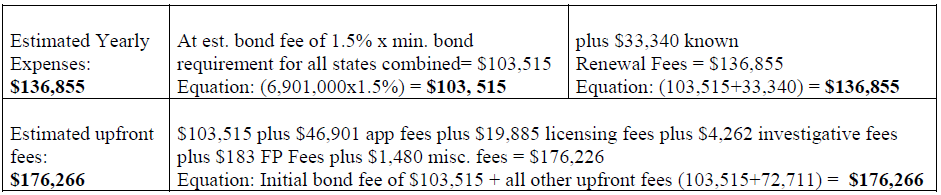
The above data was collected via research of statutory laws, government data and documents, and compilation. Research completed by Ashley Grimes.
Please click on embedded links to view locations where research data may be found.
Author: Ashley Grimes Esq. 2014